

Act V — Chapter 23: Inside the Frame
Where desire becomes visible, redistributed, and altered by a frame no one here controls.

In this chapter, the trio enters a strip-club where desire is already coded, public, and transactional. As external gazes reorganize the space, control shifts and jealousy mutates into something sharper. Exposure replaces negotiation, and the triangle discovers what it means to want inside a frame they no longer command.
Interlude précédent :

The place announces itself before we reach the door.
Bass vibrating through concrete. Neon bleeding into the street. A promise made loud enough that no one inside has to explain themselves. The desire here doesn’t ask who you are—it tells you.
We hesitate half a second outside. Not long enough to call it doubt. Long enough to register the shift.
Inside, the light is wrong on purpose. Red, violet, something between heat and bruise. Bodies arranged like furniture. Movement already choreographed. Desire with a script, looping on itself.
This isn’t a place for negotiation.
Matthieu smiles first. Not broadly—just enough to show he’s curious. Julien doesn’t smile at all. His jaw tightens, then loosens, like he’s already recalculating. I feel it in the way he stands a little closer than usual, then corrects himself.
We move in.
The room doesn’t look at us as a trio. It breaks us apart immediately. Three bodies, three readings. The gaze here isn’t personal. It’s selective.
A dancer passes close enough that I can smell perfume and sweat layered together. Her hand brushes my arm, deliberate, practiced. I don’t react fast enough. Or maybe I don’t want to.
Julien notices.
I feel it—not as accusation, not as jealousy yet, but as attention sharpening behind me. Matthieu sees it too. He doesn’t intervene. He never does at first.
We take seats near the edge of the stage. Not hidden. Not centered. The worst possible place if you want to remain observers.
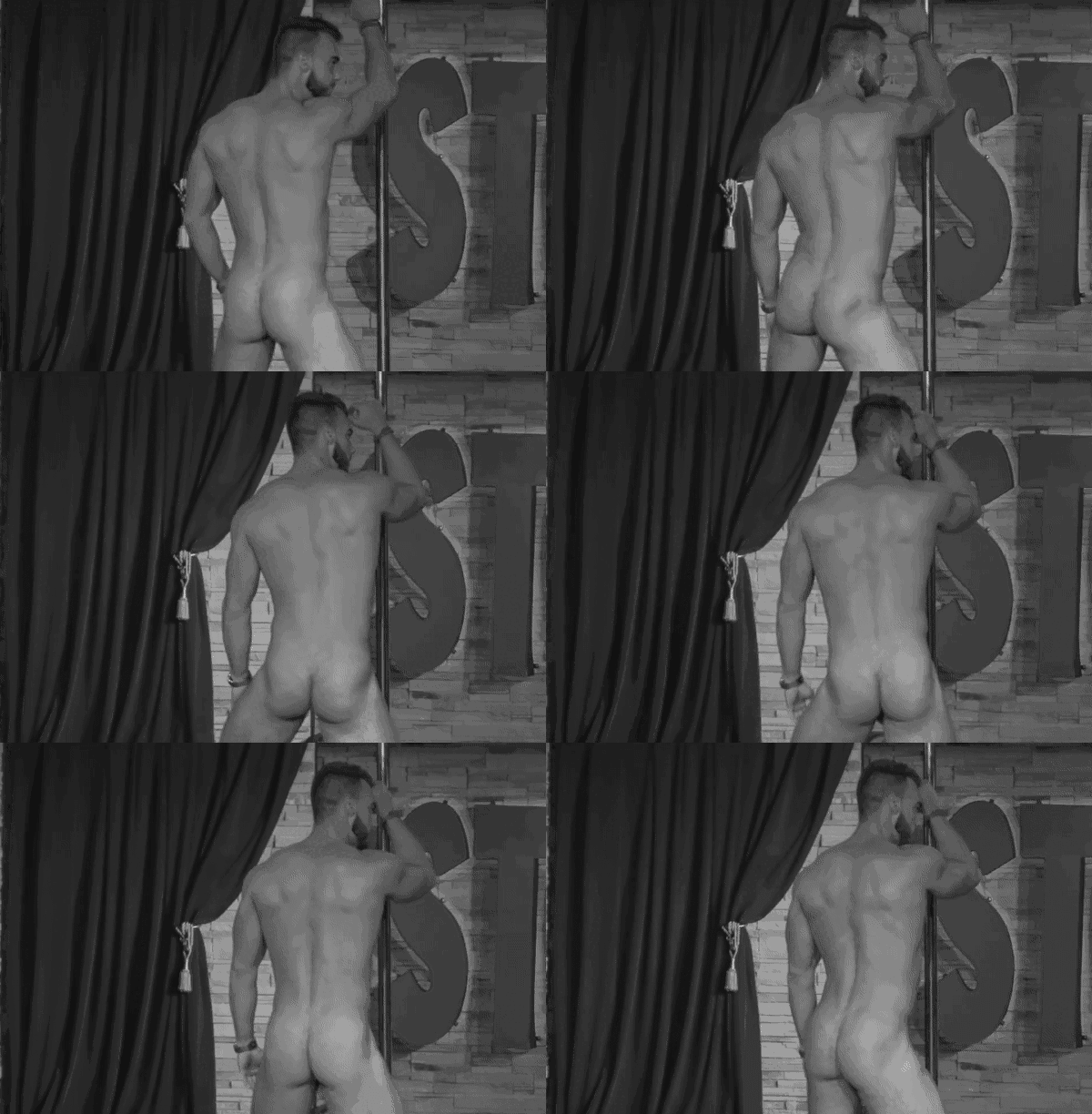
A woman climbs the pole with mechanical grace. Her movements are precise, economical. She knows exactly what reads from where. The crowd responds on cue.
I’m aware, suddenly, of my own posture. Of how still I am. Of how visible that stillness might be.
A second dancer joins her. Then a third. The light shifts. The music swells. The room tightens.
And then—without warning—it happens.
Not touch. Not invitation.
Recognition.
One of them looks directly at me. Not the way they look at everyone. Not scanning. Fixing. Her gaze lingers just long enough to test whether I’ll look away.
I don’t.
The moment stretches. Her mouth curves, satisfied. She adjusts her movement, subtly, to keep my line of sight. The performance recalibrates around that connection.
Julien shifts in his seat.
I don’t look at him. I don’t need to. I can feel the change in his breathing, the way his body stiffens as something he didn’t consent to starts taking shape.
I am no longer watching.
I am being watched.
The dancer comes closer. The distance between stage and audience collapses. Her knee presses against the edge of my space. Her hand grazes my shoulder as if by accident. The contact is light, impersonal, but it carries weight because it’s witnessed.
Julien’s leg moves once, sharp. Then stills.
Matthieu leans back, expression unreadable. He’s enjoying this—not because it’s comfortable, but because it’s clean. The desire here doesn’t pretend to belong to us. It uses us.
The dancer’s attention doesn’t waver. She knows who I am in this moment: a surface, a response, a line of tension she can pull.
I let it happen.
Not passively. Consciously.
That’s the part that surprises me.
The crowd fades. The music becomes background. What remains is the simple fact of exposure. Of being chosen without being asked. Of being folded into a script I didn’t write.
Julien finally looks at me.
Our eyes meet. There’s no anger there. No accusation. Just something raw and unsettled, like he’s watching a version of me he didn’t expect to meet so soon.
I don’t look away.
The dancer’s hand lingers at my collarbone. She leans in close enough that I can feel her breath. She says nothing. She doesn’t need to. The room understands the exchange.
Julien swallows.
I feel it then—the exact point where control shifts. Not from me to her. But from us to the place itself. The strip-club doesn’t care about our rules, our rhythms, our careful negotiations. It absorbs them and replaces them with something louder, simpler, more public.
This isn’t the restaurant.
There are no rules here that belong to us.
The song ends. The dancer pulls away, already turning her attention elsewhere. The connection snaps, clean and unceremonious.
I’m left sitting there, skin buzzing, aware of every eye that might have noticed—and every one that didn’t.
Julien exhales slowly, like he’s been holding it the whole time. Matthieu finally smiles, small and thoughtful.
“Well,” he says. “That was fast.”
No one laughs.
The lights shift again. Another song begins. Another body takes the stage.
I realize, with a clarity that lands too late to avoid, that this place hasn’t just shown us something.
It’s repositioned us.
And we haven’t decided yet whether we’re going to fight it—or follow where it leads.
Keep reading with a 7-day free trial
Subscribe to TTQ | The Triangle’s Quadrature to keep reading this post and get 7 days of free access to the full post archives.